Showing posts with label dragonflies. Show all posts

Monday, 6 June 2011

Dragon/Damselflies

This post is dedicated to the 40 or so Odonata (Dragonflies and Damselflies) species you could encounter in the UK. Really love watching the aerial master-craft of the dragonflies as they hawk around the lakes and rivers, but the alertness of these insects does frustrate when trying to get close enough to get photographs. Damselflies unlike dragonflies do allow you to get a little closer but their size means you have to get really close to get a decent photo, but they can be just as frustrating as they back off to the opposite side of the grass stem to stop you getting a picture of identifiable features. But these Odonata species are really worth the effort if you can get some pics as they as they can really show up the colouration and complexities of these insects.
                             Male Beautiful Demoiselle (Calopteryx virgo)
                                 Immature male beautiful demoiselle
                                     Female Emerald Damselfly (Lestes sponsa)
                                     Male Emerald Damselfly (Lestes sponsa)
Male Azure Blue Damselfly (Coenagrion puella)
Female Azure Blue Damselfly or a female variable blue ?
Female Azure Blue Damselfly (Coenagrion puella)
Mating Azure Blue
Male Large Red Damselfly (Pyrrhosomma nymphula)
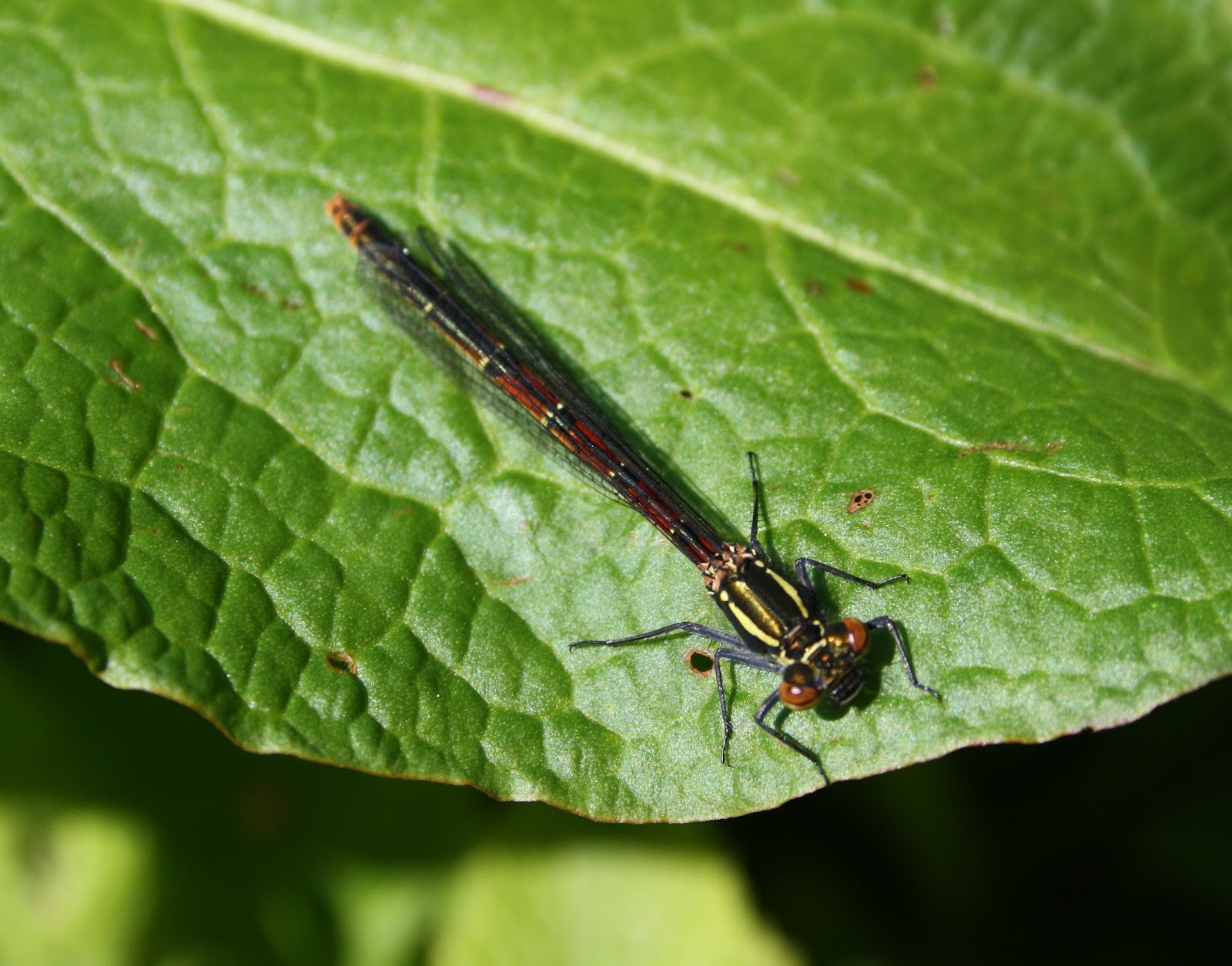
Female Large Red Damselfly (Pyrrhosomma nymphula)
Male Blue Tailed Damselfly (Ischnura elegans)
Female Blue Tailed Damselfly (Ischnura elegans violacea)
Female Blue Tailed Damselfly (Ischnura elegans rufescens)
Blue Tailed Damselfly (Ischnura elegans typica)
Female Blue Tailed Damselfly (Ischnura rufescens-obsoleta)
Blue-tailed Damselflies Mating
Male Common Blue (Enallagma cyathigerum)
Female Common Blue (Enallagma cyathigerum)
Male Emperor Dragonfly (Anax imperator)
Golden-Ringed Dragonfly (Cordulegastor boltonii)
Male Southern Hawker (Aeshna cyanea)
Migrant Hawker (Aeshna nixta)
Female Migrant Hawker (Aeshna nixta)
Female Keeled Skimmer (Orthetrum coerulescens)
Male Keeled Skimmer (Orthetrum coerulescens)
Female Broad-Bodied Chaser (Libellula depressa)
Emergent Female Broad-Bodied Chaser and exuvia
Female Four Spot Chaser (Libellula quadrimaculata)
Male Four Spot Chaser (Libellula quadrimaculata)

Male Black-Tailed Skimmer (Orthetrum cancellatum)
Female Black-Tailed Skimmer (Orthetrum cancellatum)
Female Common Darter (Sympetrum striolatum)
Female Common Darter (Sympetrum striolatum)
Male Common Darter (Sympetrum striolatum)
Mating Common Darters


Monday, 21 February 2011

5 Years of Observations at Work

Over the last 5 years at work whilst carrying out my day to day duties i have tried to keep a record of the flora and fauna species seen throughout this 35 acre site and every year a new find takes me by surprise.  The species results collected, so far, show over 80 species of birds, 134 moth species, 28 butterfly species, 12 damsel/dragonfly species, 13 mammal species, over a hundred wildflower species and 37 woody species, as well as countless other small invertebrates, lower plants and fungi. This really shows the diversity of species that can be found in a relatively small area, if you have, or are able to create some ecologically important habitats such as lakes, wetlands, woodlands and boundary habitats etc.  This year i plan on really getting stuck into identifying a lot of the smaller invertebrates as they have been neglected a little over the last few years, so my pooter has been cleaned i have already identified a couple of areas to plant a few pitfall traps and my battered copy of Michael Chinnery, Field Guide to Insects, is back out for another airing.  I have already been fortunate enough to find a couple of interesting species around the park, but my most notable to date was the Hornet Sawfly, Cimbex connatus, that was thought to be the first documented species in Cornwall.  Thanks for taking the time to read this blog and i will try to keep you upto date with how my findings are going and hopefully supply a few pics.

Click url for original Cimbex connatus photo. http://www.wildlifeuk.net/attachment.php?aid=1079